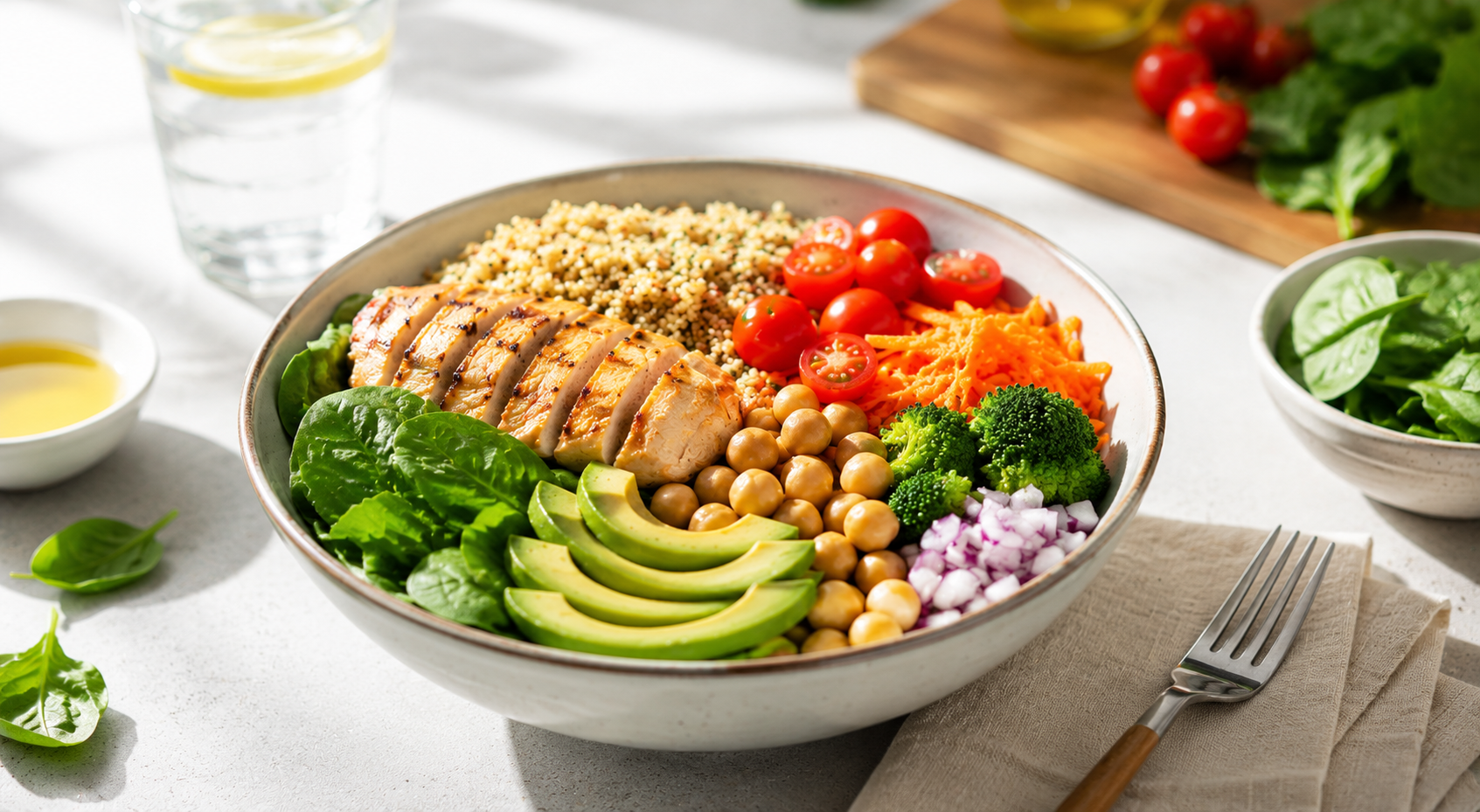
The myth of the "default" Mediterranean diet
It's common to hear that Spain "eats well because we have the Mediterranean diet." The problem is that the Mediterranean diet is a pattern you have to actively follow, not something that happens automatically from living in southern Europe. Data from Spain's National Dietary Intake Survey (ENIDE), conducted by the Spanish Food Safety and Nutrition Agency (AESAN), shows a reality further from that ideal than we tend to think.
💡 According to ENIDE, only 43% of the surveyed population eats vegetables daily, and average fruit intake falls below the recommended 3 pieces per day.
What the data says about our macronutrients
ENIDE puts average Spanish energy intake at 2,482 kcal per person per day. But beyond total calories, what's revealing is the distribution: protein and fat contribute a higher percentage of calories than recommended, while carbohydrates contribute less than desirable, a pattern that diverges from what's considered a balanced caloric profile.
In practice, this translates into consumption of fatty meats, cured meats and pastries above what's advisable, and consumption of whole grains, legumes and nuts below the ideal.
Comparison: recommendation vs. actual consumption in Spain
| Food group | General recommendation | Situation per ENIDE |
|---|---|---|
| Vegetables | Daily consumption | Only 43% eat them daily |
| Fruit | ≥3 pieces/day | Below that amount on average |
| Protein (% of calories) | Within recommended range | Above recommended range |
| Fat (% of calories) | Within recommended range | Above recommended range |
| Carbohydrates (% of calories) | Within recommended range | Below recommended range |
Why does this gap between perception and reality exist?
Several factors contribute to this disconnect:
- Cultural identity vs. actual habit: we associate the Mediterranean diet with our identity, but that doesn't guarantee we follow it day to day, especially on weekdays.
- Silent food substitution: consumption of ultra-processed products and pastries has gained ground over legumes and whole grains in recent decades.
- Distorted perception of portions: many people believe they eat enough fruit and vegetables simply by including them occasionally, without reaching daily recommended amounts.
What does ENIDE itself recommend?
The survey's official report includes concrete recommendations to bring real diets closer to the ideal: increase consumption of whole grains, fruit, vegetables, legumes, nuts and olive oil; moderate sugar intake, since high intake favors overweight, obesity and tooth decay; and moderate fatty meats, cured meats and pastries to reduce saturated fat intake.
🎯 A simple change with big impact: swapping two weekly servings of pastries or cured meat for fruit and nuts already brings the diet significantly closer to the recommended pattern.
Frequently asked questions
Is ENIDE still representative of how we eat today?
ENIDE was conducted between 2009 and 2010 on a sample of 3,000 people and remains the most cited national reference on individual dietary intake in Spain. Later studies and surveys, such as Spain's National Health Survey, confirm that the general patterns (low vegetable intake, high processed food intake) have broadly persisted.
Does this mean the Mediterranean diet "doesn't exist" in Spain?
No, it means it remains an available and accessible reference pattern, but actual population adherence is lower than popular perception suggests. Following the Mediterranean diet requires an active choice; it doesn't happen automatically.
How can I know if my own diet matches the recommendations?
The most objective way is to keep an actual log of what you eat for a few days and compare it against recommended servings for each food group, rather than relying solely on the general feeling of "I eat pretty well."
See how your body really eats
With Comeloia you can photograph your meals and objectively see how much fruit, vegetables, protein and fat you're consuming each day, without relying only on perception.


Summary: what to remember
- Only 43% of the population in Spain eats vegetables daily, according to official ENIDE data.
- Average fruit consumption falls below the recommended 3 pieces per day.
- Protein and fat intake exceed recommendations; carbohydrate intake falls short.
- Living in Spain doesn't guarantee following the Mediterranean diet: it's a pattern you have to actively choose.
- Logging your actual food intake is the most reliable way to know how close you are to the recommendations.
← Back to blog