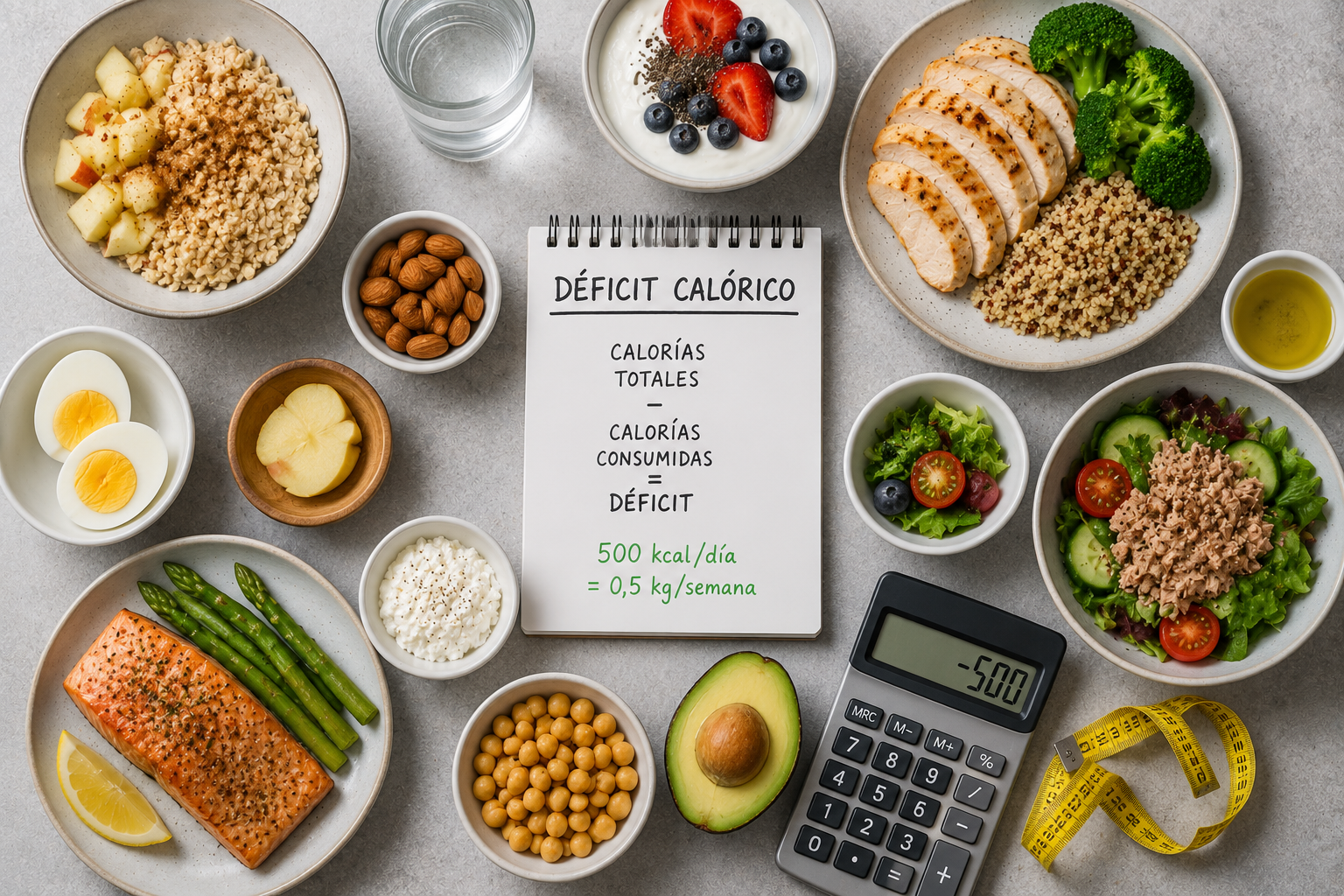
What is a caloric deficit?
A caloric deficit occurs when you consume fewer calories than your body needs to maintain its current weight. When this happens, the body turns to its energy reserves — mainly body fat — to make up the difference.
It's that simple in theory. In practice, the key lies in creating that deficit intelligently: large enough to lose fat at a good pace, but small enough to preserve muscle and avoid being hungry all the time.
💡 No food, supplement, or protocol can make you lose fat without a caloric deficit. Everything that works, works because it creates a deficit — one way or another.
Step 1: Calculate your TDEE
Your TDEE (Total Daily Energy Expenditure) is the total number of calories your body burns in a day, factoring in your activity level. It's the starting point for calculating your deficit.
It's calculated by multiplying your basal metabolic rate (BMR) by an activity factor:
| Activity level | Description | Multiplier |
|---|---|---|
| Sedentary | Little or no exercise | × 1.2 |
| Lightly active | Exercise 1-3 days/week | × 1.375 |
| Moderately active | Exercise 3-5 days/week | × 1.55 |
| Very active | Intense exercise 6-7 days | × 1.725 |
| Extremely active | Physical job + daily exercise | × 1.9 |
To calculate your BMR, you can use the Mifflin-St Jeor formula, the most accurate one currently available:
- Men: (10 × weight in kg) + (6.25 × height in cm) − (5 × age) + 5
- Women: (10 × weight in kg) + (6.25 × height in cm) − (5 × age) − 161
Step 2: Set your deficit
Once you know your TDEE, you simply eat below that number. But how far below?
| Deficit type | Calories below TDEE | Estimated loss/week |
|---|---|---|
| Conservative | 200 – 300 kcal | ~0.2 – 0.3 kg |
| Moderate ✅ | 400 – 500 kcal | ~0.4 – 0.5 kg |
| Aggressive | 700 – 1000 kcal | ~0.7 – 1 kg |
For most people, a deficit of 400-500 kcal per day is the sweet spot: enough to lose about half a kilo per week without compromising muscle mass or performance.
⚠️ Very aggressive deficits (more than 1000 kcal) significantly increase the risk of muscle loss, fatigue, nutritional deficiencies, and subsequent rebound weight gain.
The role of protein in a deficit
When you're in a caloric deficit, your body looks for energy wherever it can find it — and that includes muscle. The most effective way to prevent this is to keep protein intake high during the fat-loss phase.
Aim for 1.8 – 2.2 g of protein per kg of body weight while in a deficit. This preserves muscle mass and keeps satiety high, making the deficit much more manageable.
Why does the scale lie?
Your weight on the scale can fluctuate 1-3 kg in a single day depending on water retention, intestinal content, sodium intake, or simply the time of day. These fluctuations have nothing to do with fat.
Instead of weighing yourself every day and obsessing over the number, track these more reliable metrics:
- Weekly average: Weigh yourself every morning while fasted and calculate the weekly average. Compare averages, not single days.
- Progress photos: Every 2-4 weeks, same time, same clothes, same lighting.
- Body measurements: Waist, hips, and thigh with a measuring tape.
- How your clothes fit: The most honest indicator, and the easiest one to ignore.
Common mistakes when running a caloric deficit
Underestimating calories consumed
Studies show that people underestimate their calorie intake by 20 to 40%. Cooking oil, sauces, eyeballed portions, and small snacks add up and can easily erase a 500 kcal deficit.
Overestimating calories burned
Smartwatches and cardio machines overestimate exercise calorie burn by 30 to 100%. Don't "eat back" what the watch says you burned.
Making the deficit too aggressive
Less isn't always faster. A very large deficit spikes cortisol, reduces testosterone, hurts gym performance, and increases muscle catabolism. The result: you lose muscle, run out of energy, and the body adapts by lowering your metabolism.
Not adjusting over time
As you lose weight, your TDEE decreases. What used to be a 500 kcal deficit can turn into maintenance. Recalculate every 4-6 weeks or whenever progress stalls for more than 2 weeks in a row.
Do you know how many calories you're actually eating?
With Comeloia you log your meals with a photo and instantly see if you're within your deficit. No spreadsheets, no manual math.


Summary: what to remember
- A caloric deficit is the only proven way to lose fat — everything else is just a mechanism for creating one.
- Calculate your TDEE and eat 400-500 kcal below it for an optimal pace.
- Keep protein high (1.8-2.2 g/kg) to preserve muscle during the deficit.
- Use your weekly weight average, not the daily number, to assess progress.
- Recalculate your TDEE every 4-6 weeks or whenever progress stalls.
← Back to blog