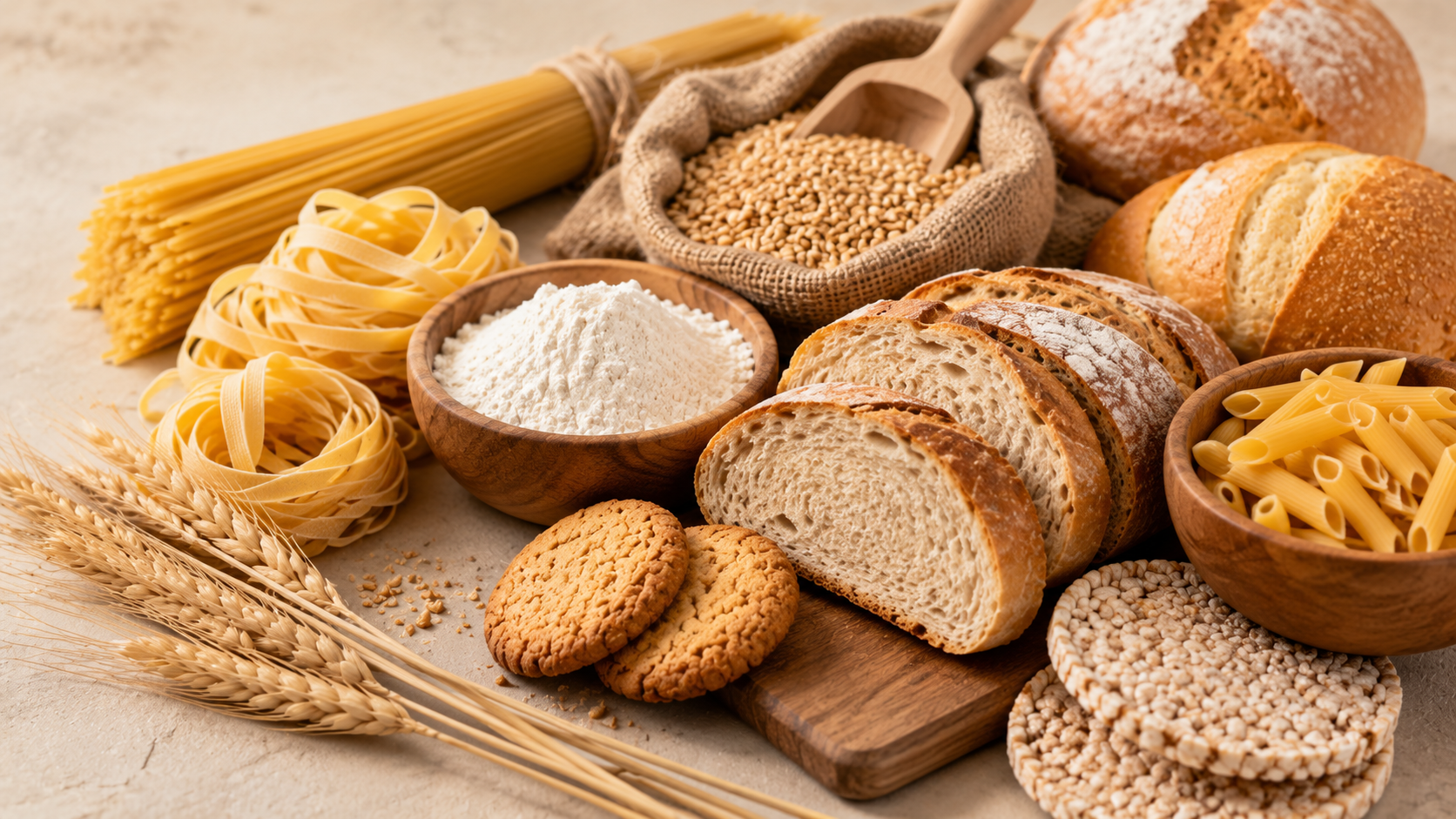
What exactly is gluten?
Gluten is a group of proteins found in wheat, barley and rye that gives elasticity to bread dough and other baked goods. For the vast majority of the population, gluten is digested without any problem and poses no health threat.
The issue arises in three quite different groups of people, who are often lumped together in popular conversation on the topic.
💡 There isn't a single "gluten sensitivity": there are at least three different conditions, with very different mechanisms and severity.
The 3 groups that react to gluten (or wheat)
1. Celiac disease
An autoimmune disease in which gluten triggers an immune response that damages the lining of the small intestine. According to estimates compiled by organizations specializing in food intolerances, it affects roughly 1% of the population. It requires medical diagnosis through serology tests and usually an intestinal biopsy, and its only effective treatment is a strict, lifelong gluten-free diet.
2. Wheat allergy
An immune-mediated allergic reaction (distinct from celiac disease) that can cause symptoms ranging from digestive to respiratory or skin reactions, and even anaphylaxis in severe cases. It's diagnosed with specific allergy tests.
3. Non-celiac gluten/wheat sensitivity (NCGS)
A condition in which someone experiences digestive symptoms after consuming gluten or wheat, without the intestinal damage seen in celiac disease or positive allergy tests. Its estimated prevalence varies widely across studies, from roughly 1% to 13% of the population depending on the review, suggesting it could be considerably more common than celiac disease, though it's harder to confirm objectively.
Comparison: celiac disease vs. gluten sensitivity vs. wheat allergy
| Condition | Mechanism | Estimated prevalence | Diagnosis |
|---|---|---|---|
| Celiac disease | Autoimmune | ~1% | Serology + intestinal biopsy |
| Wheat allergy | Allergic (IgE) | Less than 1% | Allergy tests (skin prick, specific IgE) |
| Non-celiac sensitivity (NCGS) | Non-autoimmune, mechanism not fully clear | 1% – 13% (highly variable estimates) | Ruling out the other 2 + reintroduction challenge |
What if you eat gluten-free without any of these conditions?
For someone without diagnosed celiac disease, wheat allergy or NCGS, there's no solid scientific evidence that eliminating gluten provides additional health benefits. In fact, several studies note that processed "gluten-free" products often have less fiber and fewer micronutrients, and sometimes more fat or sugar, than their gluten-containing equivalents, to compensate for texture.
🎯 If you notice improvement after cutting gluten without a prior diagnosis, it's important not to self-diagnose: in some cases, what's actually improving symptoms is FODMAPs (a group of fermentable carbs also found in wheat), not gluten itself.
Are FODMAPs and gluten the same thing?
No. Several double-blind controlled trials have found that many people who identify as "gluten sensitive" actually react to wheat FODMAPs (fructans), not gluten itself, when given a controlled challenge with pure gluten versus placebo. This helps explain why some people feel better on a gluten-free diet but show no difference in blind gluten-specific challenges.
Frequently asked questions
How do I know if I'm celiac?
Celiac disease is diagnosed through specific blood tests (anti-transglutaminase antibodies, among others) and, in most cases, an intestinal biopsy. It's essential not to remove gluten from your diet before testing, since this can skew results and complicate diagnosis.
Is it dangerous to eat gluten if I don't have any of these conditions?
No, there's no evidence that gluten is harmful for people without diagnosed celiac disease, wheat allergy or NCGS.
Are "gluten-free" products healthier by definition?
Not necessarily. Many processed gluten-free products are formulated to mimic wheat's texture and can contain less fiber and more fat or sugar than their original versions.
Log your meals without the hassle
Whether or not you have intolerances, with Comeloia you can photograph your plate and instantly see its calories and nutrients, no label-checking required.


Summary: what to remember
- There are 3 distinct gluten/wheat-related conditions: celiac disease, wheat allergy, and non-celiac sensitivity.
- Celiac disease affects around 1% of the population and requires specific medical diagnosis.
- For anyone without these conditions, there's no evidence of benefit from cutting gluten.
- In some cases, wheat FODMAPs cause discomfort, not gluten itself.
- Don't self-diagnose: consult a professional before eliminating entire food groups.
← Back to blog